Wine cabinet or wine cellar? How to decide for your space
Contents8
- 01What is the difference between a wine cabinet and a wine cellar?
- 02Which suits your space: a cabinet or a cellar?
- 03How do collection size and ageing horizon change the answer?
- 04Should you buy a ready-made cooler or have a cabinet made to measure?
- 05Should a wine cabinet have a glass door or a solid door?
- 06How do the three options compare?
- 07Which projects show the difference?
- 08Frequently asked questions
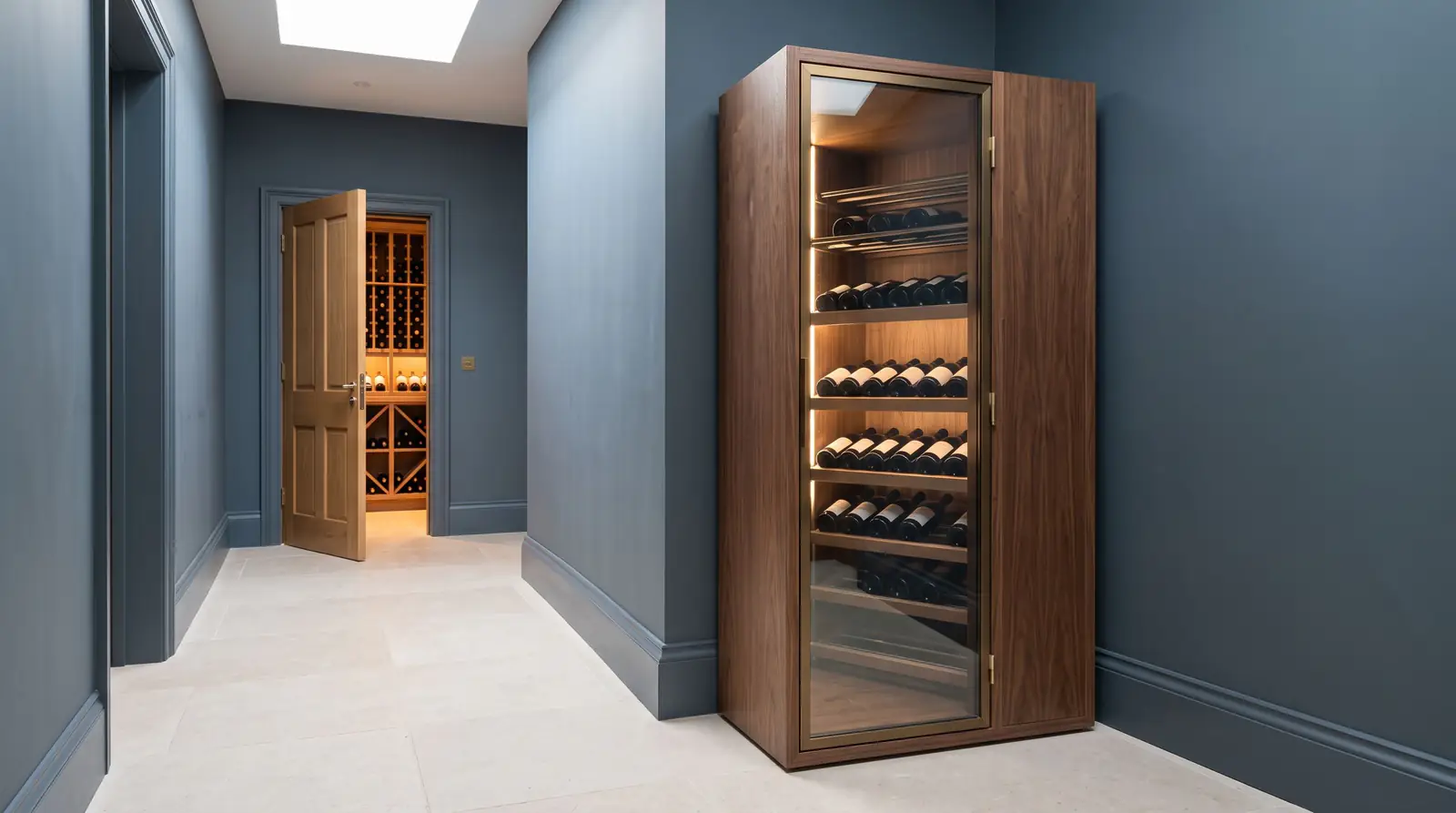
A wine cabinet is a self-contained, insulated piece of furniture that you open; a wine cellar is an insulated space that you step into and that is cooled as a whole. In the wine cabinet vs wine cellar decision, the space comes first, then the size of the collection and how long you keep bottles. A made-to-measure cabinet suits many homes that cannot enclose a full cellar.
Plans often label a tall alcove beside the dining area as a “wine cellar” before anyone has asked what the space can support. If the alcove has no ventilation, a sunny window close by and a kitchen wall on the other side, a cellar there would fight the building every afternoon. A cabinet, with its own cooling and ventilation designed in, would not.
What is the difference between a wine cabinet and a wine cellar?
A cabinet carries its own insulation and cooling inside a single piece of joinery. A cellar is built into the building, with insulation on the floor, ceiling and every wall, a vapour barrier, a sealed door and a cooling system that serves the whole volume.
That difference changes everything downstream. A cabinet is delivered and fitted into a niche or against a wall, and its climate is a property of the object. A cellar’s climate is a property of the construction around it. Cabinets are measured in shelves; cellars are measured in cubic metres of conditioned air.
People often put a third option in the same category: the ready-made appliance cooler. It is also self-contained, but it is built to a standard size, door and finish. We return to it below.
Which suits your space: a cabinet or a cellar?
The space decides, because a cellar needs a shell that can be insulated on every face, a route for exhaust heat and condensate, and a position away from heat sources. A cabinet needs a place to stand and air to breathe.
Choose a cellar when:
- the space can be enclosed and insulated on all faces, including the floor and ceiling;
- there is a place for the cooling unit to reject heat, and a route for condensate;
- you want to walk in, browse the bottles and perhaps taste or serve there;
- the collection is large, or you expect it to grow into the space.
Choose a cabinet when:
- the space is shared with a kitchen, a dining area or a living area;
- the available space is a niche, an alcove or a wall of joinery;
- the home is rented, or you expect to move;
- you want the bottles to be part of the interior without turning a space over to them.
If the space is small and you are still unsure, our guide to small-space wine cellars covers what a compact cellar still needs.
How do collection size and ageing horizon change the answer?
Bottle count pushes towards a cellar; the length of time you keep bottles pushes towards stable construction, whichever form it takes. A collection meant for drinking over the next few years can live in a well-made cabinet. A collection meant for ageing over many years needs a very stable temperature, and stability is a matter of construction.
A cabinet can hold 12–14 °C (54–57 °F) if it is built properly, with continuous insulation and a unit sized to the load. A cellar can fail to hold it if the shell is poor. Neither form is stable by default; what matters is whether the insulation, vapour control and cooling were designed together. For the targets themselves, see wine cellar temperature and humidity.
Should you buy a ready-made cooler or have a cabinet made to measure?
A ready-made appliance suits a modest, quick solution in a standard position; a made-to-measure cabinet suits a space with its own dimensions, a design brief and a long-term collection. The appliance is built for a catalogue; the cabinet is built for your wall.
ARDINART Wine Cellars is an Istanbul design and production workshop for made-to-measure wine cellars and wine cabinets, installed by its own team. A made-to-measure cabinet from Ardinart is drawn to the exact opening, with the door in timber, glass or metal as the interior requires. Humidity is balanced inside, the choice of glass or door protects bottles from UV, and the construction is built to keep vibration away from the bottles. Drawers, display areas and lighting are designed with it. For a general view of appliance coolers, see our guide to wine cooler cabinets and our full custom wine cabinet range.
Should a wine cabinet have a glass door or a solid door?
Glass shows the bottles and timber or metal conceals them, and each has consequences for heat and light. A glass door gives a view of the collection, but it adds heat load and exposes bottles to light, so the glazing needs UV protection and the lighting needs to be LED, which gives off little heat and very little UV. A solid timber or metal door keeps the collection private and the interior calmer.
Display suits some interiors and discretion suits others. A common answer is a cabinet with a glass section for a few chosen bottles and solid doors for the rest.
How do the three options compare?
| Option | Built as | Suits |
|---|---|---|
| Appliance cooler | Standard unit, standard size | Modest collections, quick set-up |
| Made-to-measure cabinet | Fitted furniture with its own cooling | Niches, joinery, yachts, rented homes |
| Cellar | Insulated space with its own cooling system | Large collections, long ageing, tasting |
Which projects show the difference?
Three of our projects each answer the question differently, and none is the answer for everyone.
For Merit Hotels we made two custom cabinets: one built into a wall niche in the restaurant bar, and one in an outdoor area. Both are cabinets rather than cellars, which fits the spaces: a bar wall and an outdoor area, where there is no volume to enclose.
Lara Barut Collection is a cellar on the lowest floor of a villa, with natural timber, soft LED lighting, different bottle storage units and a serving and tasting table. A lowest-floor space of that kind can be enclosed and insulated on every face, which is where a cellar makes sense.
For a yacht built by Numarine we designed a refrigerated wine cabinet, going from sketch to 3D drawings to production and installation (Numarine wine cabinet project). On a yacht the cabinet is the form that fits the volume available.
For service-led layouts see restaurant wine display and hotel cellars; for what drives the budget see what a custom wine cellar costs. Our services page explains how a discovery meeting turns this decision into drawings.
Frequently asked questions
Is a wine cellar the same as a “wine room”?
Yes, in everyday use. “Wine room” is a common way to search for it, and it points to the same thing: an insulated, separately cooled space that you step into. We call it a wine cellar and talk about the space, because construction defines it: insulation on every face, a sealed door and cooling sized to the heat load. The label matters less than those three things, wherever the space sits in the building.
Can a cabinet be upgraded to a cellar later?
Not by adding to it. A cabinet’s cooling and insulation are part of the object, while a cellar’s belong to the building. If you may want a cellar in future, mention it on the discovery call. A cabinet can be designed to stay in use as a service cabinet beside the cellar when the collection grows.
Is a dual-zone cabinet enough for ageing?
Dual-zone designs are made for serving temperatures: one zone for whites, one for reds. Ageing needs one stable temperature, around 12–14 °C (54–57 °F), and one zone of a dual-zone cabinet can supply it if it holds steady. The question is not zones but whether the cabinet holds its setting without daily swings.
Which needs more maintenance?
Both need the same basics: clean filters and coils, a check of door seals and a look at the temperature log. A cellar has more elements to inspect, such as the door, the envelope and the cooling plant, while a cabinet is one object. A made-to-measure cabinet is easier to service when access to the cooling unit is designed in.
Can a cabinet be built into joinery?
Yes, and this is one of the main reasons to have one made. The cabinet can be drawn into a kitchen, a dining area or a wall of storage so that doors, materials and lines continue across the whole run. Ventilation for the cooling unit is designed with the joinery rather than added afterwards.
The choice between a cabinet and a cellar often becomes clear at the space itself. Book a discovery call and we will look at the walls, the light and the collection with you.