Yacht wine storage: protecting a collection at sea
Contents8
- 01What makes storing wine on a yacht different?
- 02Where on board should wine be stored?
- 03How do you stop bottles moving at sea?
- 04What climate control does a yacht wine cabinet need?
- 05Which materials suit salt air and sun?
- 06How does the cabinet fit with the interior and the yard’s schedule?
- 07How does Ardinart approach yacht cabinets?
- 08Frequently asked questions
Good yacht wine storage keeps bottles at a steady cool temperature, around 12–14 °C (54–57 °F), in a cabinet with marine-grade refrigeration, individually retained bottles and a temperature alarm. Where the yard allows, it sits low in the vessel, away from engine heat and sun, and it is designed with the yard rather than added after the interior is finished.
A faint chime of glass on glass from behind a joinery panel, heard in the saloon in a following sea, usually means bottles are touching. It is a small sound, and it tells you the storage was specified as furniture rather than as a system for a moving, warm, salty vessel. This article explains what the system has to do, and where the decisions are made.
What makes storing wine on a yacht different?
A yacht combines four conditions that a house cellar rarely has to face together: motion, heat, salt air and a power supply that changes with the vessel’s mode. Each one is manageable. The failure comes from designing for none of them.
Insurer Chubb, in its guide on collecting fine wine on board, puts temperature stability first. It recommends a stable temperature of about 13 °C (55 °F), marine-grade wine refrigeration, a temperature sensor that alerts you when the reading moves outside a set range, and a backup power source in case the main generator fails. It also points to engine rooms, galleys, exterior bulkheads and direct sunlight as places to avoid. We build on the same priorities. The four conditions break down as follows.
- Motion. Bottles move, touch and can break. Published evidence is limited: the AWRI found no literature on harm from compressor vibration, but securing bottles against motion protects glass, labels and sediment regardless.
- Heat. Purdue Extension’s guidance on wine storage notes that any temperature above 16 °C (61 °F) accelerates maturation and can shorten a wine’s life, especially whites, and that above 24 °C (75 °F) most wines age greatly and untypically. A sun-heated deck or a warm port gets there easily.
- Salt air. Fittings, fasteners, controllers and finishes all face a corrosive atmosphere.
- Power. The cabinet has to keep running when the vessel changes from shore power to generator, and when a generator is under maintenance.
Where on board should wine be stored?
Store it in the most stable part of the vessel the yard can offer, off the floor and away from engine heat and direct sun. Position and neighbours matter as much as any feature of the cabinet.
Stability and weight are the two reasons. Chubb refers to the most stable areas of a vessel as the place for valuable bottles, and a heavy loaded cabinet is easier to carry low. Whether a particular location can carry the weight is a question for the yard’s naval architects and structural engineers, and we leave that answer to them.
Then look at what is on the other side of each panel. The engine room, the galley, an exterior bulkhead that takes the afternoon sun and a skylight or window are all sources of heat or light. A cabinet also has to reject its own heat, so it needs a route for air. A beautiful niche with no ventilation behind it makes the cooling unit work harder.
Access matters too. The cabinet should open where the crew can serve without crossing guest areas, and the unit needs to be reachable for servicing without moving the racking.
How do you stop bottles moving at sea?
You hold every bottle individually, with a fitted cradle that supports it and a retainer that stops it leaving. Bottles that rest against each other are the problem, and no amount of padding between them replaces proper retention.
Chubb suggests storing bottles snugly but not overcrowded, and mentions bottle leashes or retention straps.
- Measure the bottle formats you actually hold. Bordeaux, Burgundy, sparkling and magnum bottles differ in diameter and shoulder, and each needs its own cradle.
- Line every contact point with a soft material so that glass never meets glass or bare metal.
- Hold the bottle at the neck or the shoulder and the base, so it cannot slide along its axis as the vessel heels.
- Fit positive door catches so that the door cannot swing open under motion.
- Keep bottles lying horizontally, as in any cellar, so the cork stays in contact with the wine.
Retention is part of the joinery drawing and has to be right before production starts, because a cradle cut for a Bordeaux bottle may not hold a champagne bottle.
What climate control does a yacht wine cabinet need?
It needs refrigeration made for marine use, an insulated cabinet with sealed doors, and a sensor with alerts. The cooling unit is sized from the heat load of the cabinet and its surroundings, not from the number of bottles.
The temperature target is the same as on land: a stable value around 12–14 °C (54–57 °F), with stability valued above the exact figure. Relative humidity of about 60–70% keeps corks from drying and stops labels from deteriorating; Chubb gives 60–65%. On a vessel the practical difficulty is holding that steady, because the cabinet’s surroundings swing between air-conditioned saloon and sun-baked deck.
| Risk on board | What it does | What to specify |
|---|---|---|
| Warm surroundings | Raises heat load, ages wine | Heat-load calculation, insulated cabinet |
| Unit failure | Temperature drifts unnoticed | Sensor with alert to crew device |
| Power change | Cooling stops at switchover | Backup supply and a power-loss alert |
| Open door | Warm humid air enters | Positive catch, door-open alert |
Alarms are only useful if the right person receives them. Decide in advance whether the alert goes to the chief stewardess, the engineer or the captain, and what each person does on receiving it. Our guide to smart wine cellars covers thresholds and escalation, and the numbers behind the targets are in wine cellar temperature and humidity. For the planning logic that applies to any cellar, see our four-step guide to creating a wine cellar.
Which materials suit salt air and sun?
Choose materials that tolerate salt, humidity and UV, and ask for the grade in writing. A wine cabinet on a yacht has to survive the marine environment even though it sits inside the interior.
Our palette includes walnut, oak, chestnut, ash and acacia, with glass, brass, bronze, stainless steel, leather and acrylic. On board, the selection narrows. Metals and fasteners should be chosen for marine exposure, and the stainless grade should come from the yard’s specification. Timber finishes should be stable under humidity change and low in odour once cured. Glass doors should block UV, since the sun reaches into saloons through large windows. Lighting should be LED, which gives off little heat and very little UV.
There is no general rule that says one timber is better than another aboard. The right answer follows the interior concept, the surrounding climate and the yard’s finish standards.
How does the cabinet fit with the interior and the yard’s schedule?
Bring it into the design when the interior layout is still open, then coordinate it as part of the build. A wine cabinet touches joinery, electrics, ventilation and sometimes plumbing, and every one of these belongs to a different trade on the yard.
Plan the route by which the cabinet reaches its position: hatches, doorways and stairs limit what can be carried in one piece. Building the cabinet in modules that are fitted on board is one answer. Another is to install the cabinet before panels close around it.
How does Ardinart approach yacht cabinets?
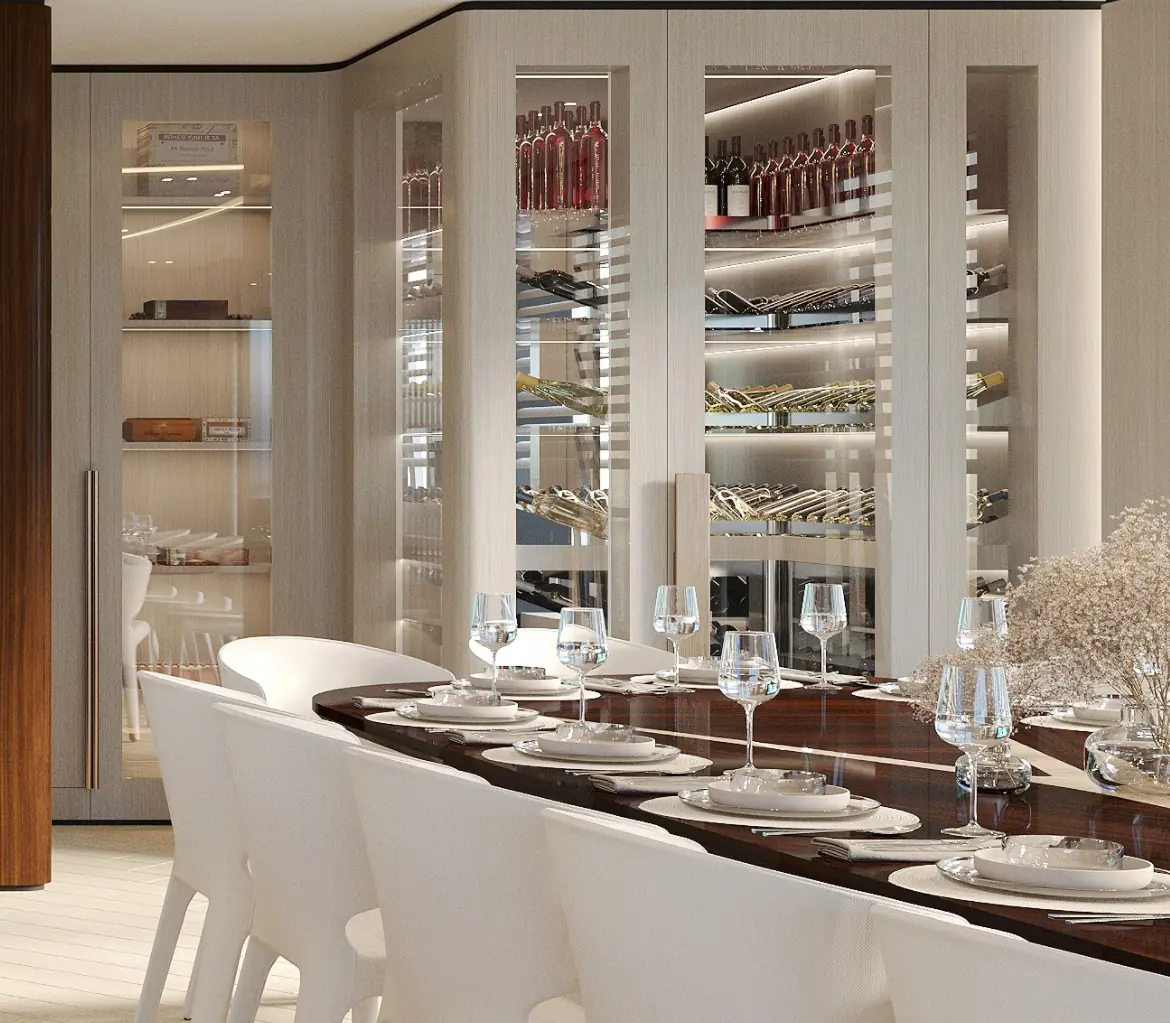
ARDINART Wine Cellars designs, builds and installs made-to-measure wine cellars, cabinets and storage at its own facility in İkitelli OSB, Istanbul. We work as an extension of the yard’s and designer’s teams. Our process has four steps: discovery meeting, design with drawings and material samples, production in our own facility, and installation by our own team.
For Numarine, we designed and built a refrigerated wine cabinet for one of the yard’s yachts, from sketch to 3D drawings to production and installation. See the Numarine wine cabinet. For Sirena Yachts we made a personalised cabinet for a yacht model that Sirena built for its client; the Sirena Yachts cabinet page has the details. The Bering Yachts cabinet is a concept design shown as a 3D render. It has not been built, and we mention it to show a direction rather than a result.
More detail on our cabinets is on the custom wine cabinet page. We have also written about this in Turkish: Yatlar için şarap dolabı.
Frequently asked questions
What temperature should a yacht wine cabinet hold?
A stable temperature around 12–14 °C (54–57 °F). Chubb recommends approximately 13 °C (55 °F) on board. Stability matters more than the exact figure, so the cabinet should hold its setting while the surrounding temperature changes through the day, with an alert if the reading leaves the set range.
Can a household wine fridge be used on board?
A household unit is designed for a fixed building: a level floor, steady mains power and calm, dry air. Chubb advises marine-grade refrigeration for yachts. A domestic unit is therefore a risk, and the specification should be agreed with the yard’s engineers.
How do you stop bottles rattling?
With individual cradles and retention for each bottle, soft contact surfaces and no glass-on-glass contact. Bottles should be held snugly but not crowded. The cradles are cut to the bottle formats you hold, so the formats must be known before production.
Should bottles be moved for long passages?
Chubb advises avoiding frequent relocation of bottles between cooling zones, while suggesting that especially valuable bottles may be moved to the most stable areas during rough seas or extended voyages. A well-built cabinet with retention and an alarm reduces the need to move anything.
Do you work directly with shipyards?
Yes. We have designed and built cabinets for yachts from Numarine and Sirena Yachts. We work from the yard’s drawings and interior concept, and agree dimensions, services and finishes with the yard’s teams and the designer. The earlier the yard involves us, the more freely the cabinet can be placed, ventilated and serviced.
If you are specifying wine storage for a new build or a refit, book a discovery call with us. Our services explain how the work runs from survey to installation.